


A U.S. defense contractor has unveiled a model of an upgraded F-22 variant dubbed “Raptor 2.0,” expected to feature stealthy external fuel tanks and infrared sensors.
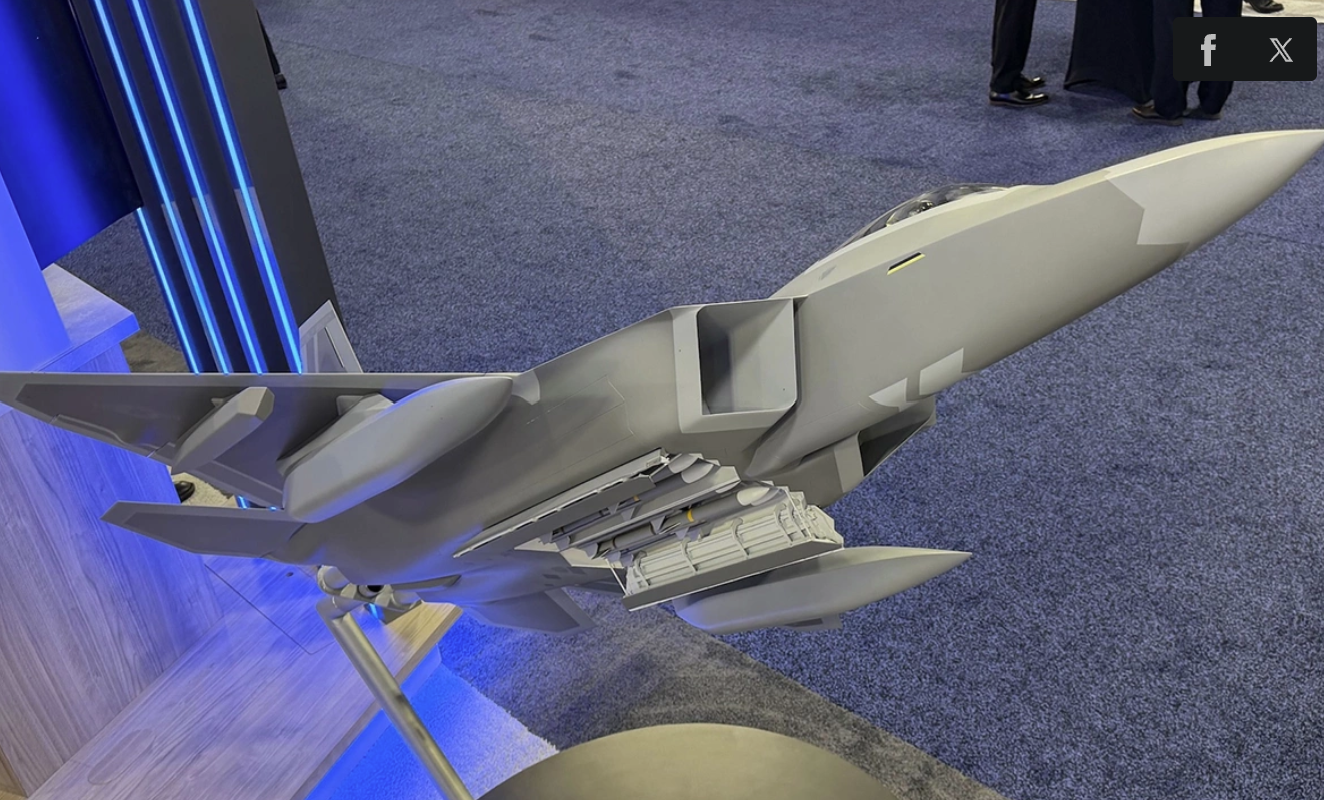
At its exhibition booth during the annual conference hosted by the Air & Space Forces Association on February 24, Lockheed Martin displayed a scale model representing the production version of the new F-22 stealth fighter variant known as “Raptor 2.0.”
The aircraft would serve as an upgraded version of the F-22 Raptor, currently the most advanced stealth fighter in the U.S. inventory and operated exclusively by the U.S. Air Force. Washington has long declined to export the F-22, even to its closest allies, in order to preserve absolute air superiority.
The most notable feature of the upgraded model is its stealth external fuel tank, designed to extend the fighter’s operational range across vast theaters such as the Indo-Pacific. The angular, low-drag tank can reportedly be jettisoned, allowing the F-22 to restore full combat performance and stealth characteristics when required.
The United States previously developed external fuel tanks with a capacity of more than 2,200 liters to address the F-22’s limited range. However, the solution proved impractical, as the tanks compromised the fighter’s stealth capabilities against advanced enemy air defense systems.
Nevertheless, F-22 fighters stationed in Alaska routinely carry external fuel tanks due to the nature of their missions, which often involve long-duration intercept, identification, and escort operations over vast areas.
The new-generation F-22 variant is also expected to incorporate redesigned stealthy equipment pods, including a high-performance Infrared Search and Track (IRST) system. The manufacturer had originally planned to equip the F-22 with IRST, but the system was ultimately removed to reduce costs.
IRST is an infrared sensor designed to detect and track heat signatures emitted by enemy aircraft engines. Operating passively, it does not emit signals that could alert a target, unlike radar systems. Often described as a “silent eye,” IRST is capable of detecting stealth aircraft and identifying small targets such as unmanned aerial vehicles (UAVs) and cruise missiles.
“Although the IRST sensor housing would still have some impact on the F-22’s radar cross-section, the trade-off could be worthwhile given its operational benefits,” said Thomas Newdick, editor at U.S. defense publication The War Zone. “F-22s equipped with IRST could share data with aircraft that do not carry the system, enhancing overall situational awareness.”
The United States has completed testing of a new external fuel tank for the F-22 Raptor and could begin deliveries as early as March. Meanwhile, the IRST sensor pod is expected to undergo operational testing and evaluation around mid-year.
“The decision to approve new underwing stealth attachments for the F-22, including a relatively large component, could pave the way for integrating similarly sized systems on the aircraft in the future,” Thomas Newdick wrote in The War Zone.
In parallel, the U.S. is pursuing broader upgrades to ensure the F-22 retains its edge. Enhancements include increased computing power, upgraded radar, new communications systems, improved defensive aids, and other advanced equipment.
The F-22 was developed under the Advanced Tactical Fighter program, launched in 1981 to replace the F-15 and F-16 fleets. A total of 195 aircraft were built, including eight prototypes and 187 production fighters.
The aircraft can reach speeds exceeding 2,400 km/h at high altitude and nearly 1,500 km/h at low altitude. It is armed with an M61A2 20 mm six-barrel rotary cannon and features eight internal hardpoints for air-to-air missiles, air-to-ground munitions, or bombs. Four external hardpoints can carry fuel tanks, missiles, or other equipment.
