


Global gold prices surged more than $120 per ounce, while the Dow Jones Industrial Average posted its steepest one-day decline in a month.
At the close of trading on February 23, spot gold rose $121 to $5,227 per ounce. Prices extended gains in early trading on February 24, climbing to $5,250 per ounce — the highest level since January 30.
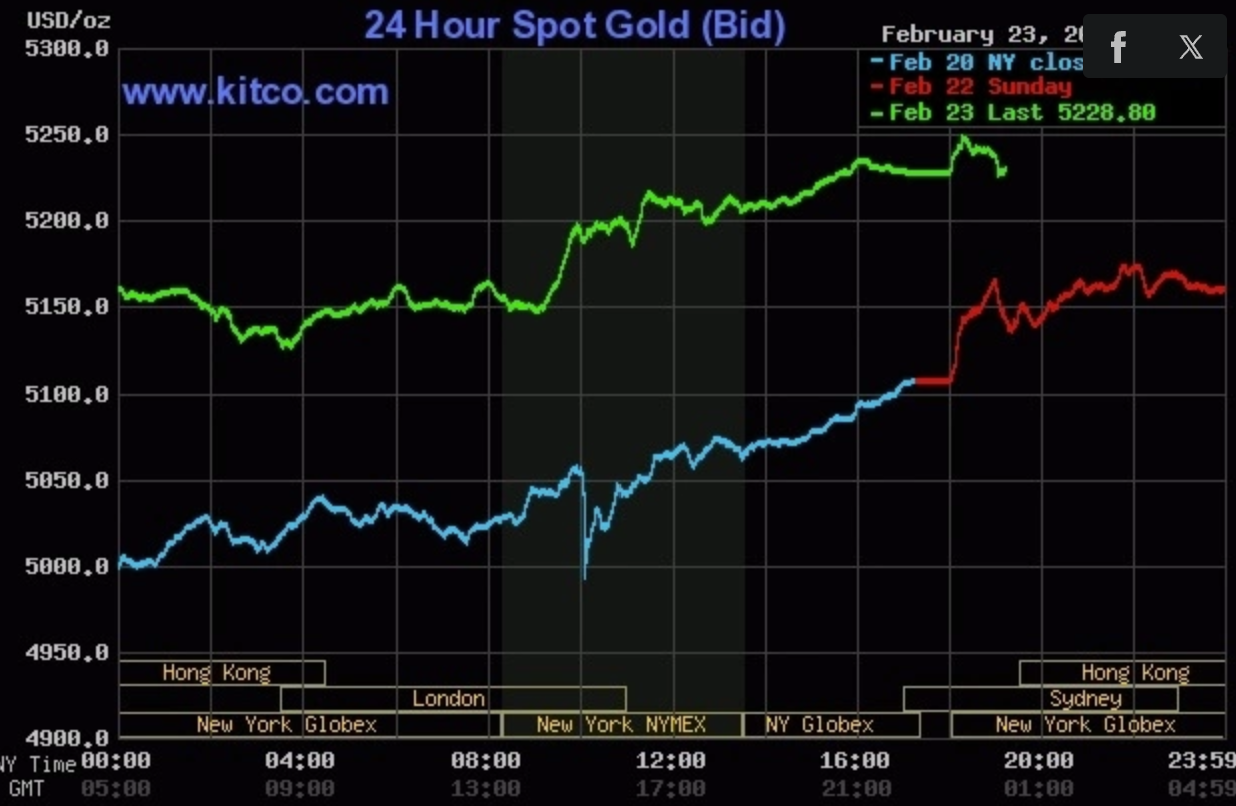
The rally was fueled by a wave of safe-haven buying amid uncertainty surrounding U.S. trade policy. After the Supreme Court of the United States struck down several import tariff measures, President Donald Trump swiftly responded by imposing new duties. Writing on Truth Social on February 23, he criticized the court’s ruling and warned of further tariff increases.
“There are simply too many political and economic issues around the world,” said Jeffrey Christian, managing director of CPM Group. “We expect prices to rise strongly this week as normal activity resumes following the Lunar New Year holiday.” The Chinese market — the world’s largest gold consumer — reopened on Monday.
“Over the next few quarters, we believe gold prices will continue climbing and could set additional records,” Christian added.
Data released late last week showed U.S. inflation rose more than expected in December 2025. Other reports pointed to a marked slowdown in economic growth in the fourth quarter, potentially prompting the Federal Reserve to delay interest-rate cuts.
Investors this week are awaiting further remarks from Fed officials while closely monitoring tensions between the United States and Iran. Gold is widely viewed as a store of value during periods of political and economic volatility and tends to benefit from lower interest rates.
Beyond gold, silver climbed 3.2% to $87.2 per ounce, while palladium edged up to $1,750. Platinum, however, slipped 0.7% to $2,140 per ounce.
On Wall Street, uncertainty over Trump’s new tariff measures and concerns that artificial intelligence could disrupt multiple sectors weighed on equities. The Dow Jones Industrial Average tumbled 823 points, or 1.6%, marking its steepest decline in a month. The S&P 500 fell 1%, while the Nasdaq Composite dropped 1.1%.
Shares of American Express slid 7.2%, their lowest level since April 2025. DoorDash and KKR fell 6.6% and 8.9%, respectively, while IBM plunged 13%. More than 60% of S&P 500 constituents closed in negative territory.
“When you have this many uncertainties hitting at once, it’s not surprising to see a sharp pullback in stocks,” said Matt Maley, chief market strategist at Miller Tabak + Co. Import tariff uncertainty is expected to continue influencing Wall Street this year, though volatility may not be as severe as in 2025.
