


Once the driving force behind Germany’s export boom, China is now increasingly seen as a direct trade rival to Europe’s largest economy.
On February 25, German Chancellor Friedrich Merz will begin his first official visit to China. He will be accompanied by a delegation of around 30 business leaders to Beijing and Hangzhou — a major hub for humanoid robotics.
In preparation for the trip, Merz convened a meeting on February 17 with leading China experts in Germany. Among those in attendance was Jörg Wuttke, who represented chemical giant BASF in China from 1997 to 2024 and currently serves as President of the European Union Chamber of Commerce in Beijing.
“The chancellor wanted to understand how to build relationships with Chinese officials. He is preparing for this visit very carefully,” Wuttke said.
According to Le Monde, German public opinion is divided over how to respond to what many see as a historic shift in economic relations between Europe’s and Asia’s largest economies. For the past two decades, bilateral trade has largely been complementary, driven by China’s strong demand for German chemicals, automobiles and industrial machinery.
The arrangement proved mutually beneficial: China’s rapid industrial ascent helped fuel significant prosperity in Germany throughout the 2010s. But that era, observers say, has come to an end. “We are witnessing a brutal decoupling,” Wuttke remarked.
China has now emerged as a net global exporter of machine tools and automobiles — sectors long dominated by Germany’s traditional industrial base. Fueled by excess production capacity, Chinese manufacturers are intensifying competition not only at home but also across international markets, where exports benefit from a relatively weak renminbi.
Meanwhile, German industry is steadily losing market share. Many manufacturers are struggling, cutting costs and shedding jobs. According to figures released in mid-February by auditing firm EY, some 266,000 industrial jobs have disappeared since 2019. The automotive sector has been hit hardest, accounting for 111,000 of those losses.
Jörg Wuttke has witnessed the shift firsthand. For 25 years, BASF’s China operations did not require a single euro in funding from Germany. Major projects were financed locally, either by Chinese partners or through substantial profits generated in the market, with €1–2 billion remitted annually to headquarters. “But that source of earnings has now dried up,” he acknowledged.
A similar pattern has unfolded in the auto industry. For years, Volkswagen’s China profits flowed back to its headquarters in Wolfsburg — until the carmaker was forced into restructuring in 2025. Recently, Volkswagen, along with BMW and Mercedes-Benz, has warned of weakening sales. Data from Eurostat show that German car exports to China have fallen by two-thirds since 2022.
Competitive pressures are spreading into other industries. Last year, German exports of goods to China declined 9.3% to €81.8 billion ($97 billion), the lowest level in a decade, while imports from China surged.
Andrew Small, director of the Asia program at the European Council on Foreign Relations (ECFR), said Germany is experiencing a “China shock.” “The two economies that once complemented each other are now operating as competitors,” he noted.
Research firm Rhodium Group in New York reports that China is capturing German market share in machinery, chemicals and electrical systems. It warns that German exports to China have entered a phase of “structural decline.” Unless industry finds alternative markets, the wave of bankruptcies and job cuts already underway in Germany is “likely to intensify.”
“China used to be a gold mine for Germany’s multinationals. But over the past three years, a quarter of that trade volume has vanished,” said Noah Barkin of Rhodium Group. According to Germany Trade & Invest (GTAI), China ranked as Germany’s largest or second-largest export market for many years. By 2024, it had slipped to fifth place and is estimated to have fallen to seventh last year.
Some industry associations representing Germany’s Mittelstand are calling for a tougher stance, including reshoring production and raising barriers to foreign imports. “These calls reflect deepening concern about competition from China, which has become particularly acute over the past year,” Barkin said.
Major corporations, however, are pursuing a different approach, viewing China as a laboratory for future industries rather than a market to retreat from. In late 2024, Bosch closed autonomous-driving research facilities in Stuttgart to invest more heavily in China, arguing that technology must be developed where it is deployed.
In effect, this amounts to recognition that China has built an innovation ecosystem of extraordinary speed and scale. Xinhua cited a survey by the German Chamber of Commerce showing that advances in innovation in China are having positive spillover effects on German corporate headquarters.
Wuttke describes China as “a gym for industrialists.” “The Chinese are at least six years ahead of us in embedded software and two years ahead in chassis technology. We are learning how they manufacture competitive electric vehicles,” he explained.
Even so, the European Chamber of Commerce president in Beijing acknowledged that Europe still needs targeted protective measures in certain sectors. Barkin was more blunt: “Germany will have to implement some defensive measures — otherwise its industrial base could disappear within a few years.”
Arriving in China this week, Chancellor Friedrich Merz faces pressure to strike a delicate balance: affirming China’s importance to German industry while pressing Beijing to address longstanding concerns over market access and industrial overcapacity.
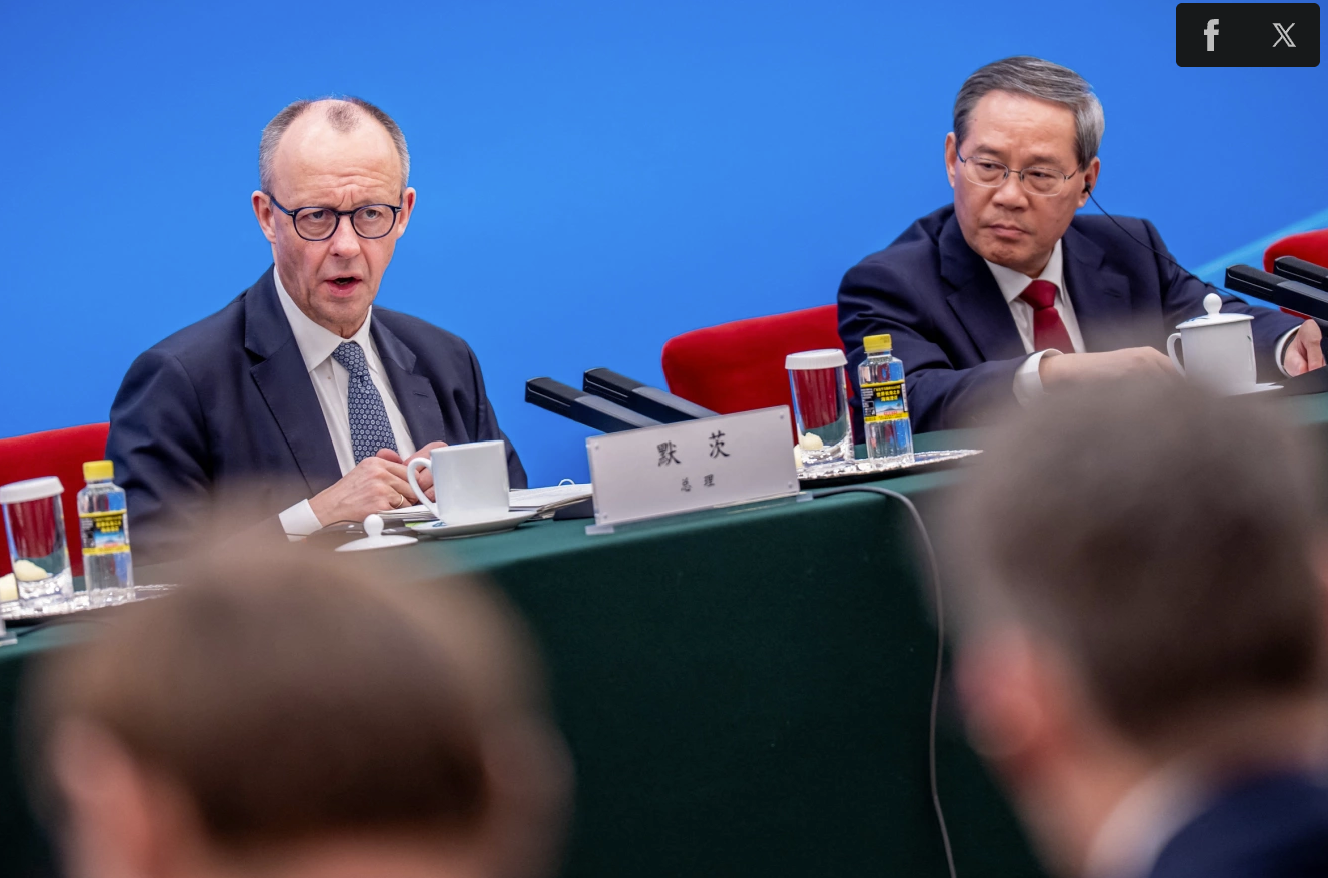
Meeting Chinese Premier Li Qiang on February 25, Merz said Germany attaches great importance to maintaining and deepening economic exchanges, while emphasizing the need for fair cooperation and open communication.
“We have very concrete concerns regarding our cooperation and would like to see improvements to ensure greater fairness,” Merz said. Li, for his part, called on both countries to safeguard multilateralism and free trade.
Stefan Messingschlager, a China historian at Helmut Schmidt University in Hamburg, argued that Berlin’s most realistic objective is to recalibrate ties toward what he described as “controlled stability.”
At the same time, Germany should reduce dependencies on rare earths, pharmaceutical precursors and critical industrial software. Rather than tackling challenges purely on a bilateral basis, he suggested Berlin could draw more actively on EU instruments such as anti-dumping and anti-subsidy measures.
China’s state-backed Global Times sought to reassure, arguing that the appeal of a vast consumer market of more than one billion people outweighs concerns about competition. Claims that China is a “systemic rival,” it suggested, have at times complicated Germany’s policy approach.
“The enthusiasm and actions of the German business community speak louder than political slogans,” the newspaper concluded.
